

What an amazing weekend at Finchley Reform Synagogue. I was delighted and honoured to deliver the sermon in honour of the wonderful Rabbi Eleanor Davis and her rabbinate at FRS, and to attend a phenomenal concert celebrating 50 years of women cantors and the extraordinary leadership of Cantor Zoe Jacobs.
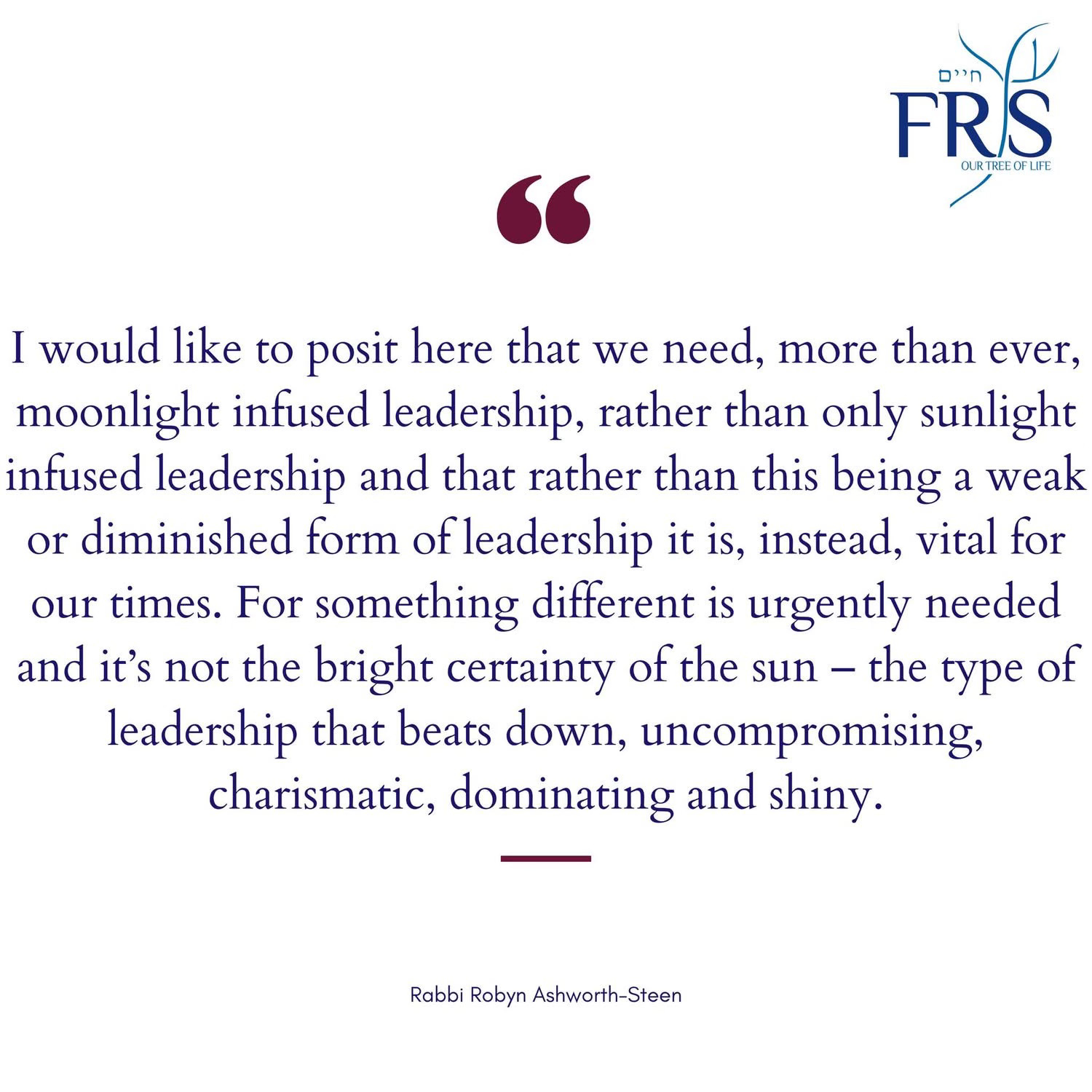
My sermon, which you can find here, in text and video, looks at moonlight infused leadership - uplifting quiet, reflective, thoughtful leaders, who are so needed for today. You can also find a copy of the text below.
For Rabbi Eleanor Davis, FRS
20 December 2025/30 Kislev 5786
Moonlit Infused Leadership: ‘What Use Is a Candle In The Middle Of The Day?’
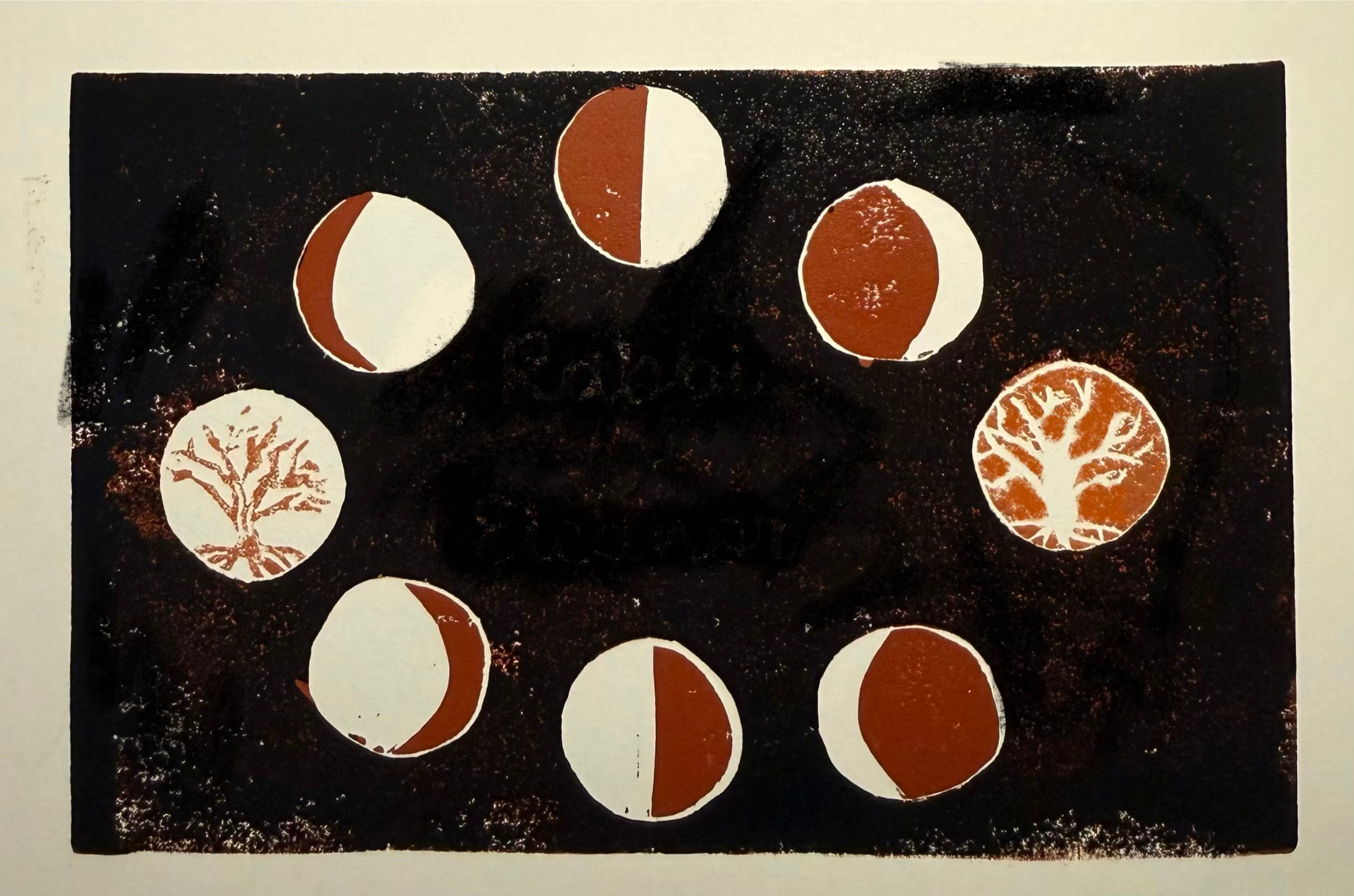
I am truly delighted to be here today to honour Rabbi Eleanor and her rabbinate here at FRS. I have the joy of sharing some words of Torah and reflection to celebrate Rabbi Eleanor, her love of all things lunar, and her commitment to teaching, Judaism, community and divinity. I’m going to offer three stories/teachings as lights/illuminations for today.
Firstly, the rabbis of the Talmud invite us to join them in a radical act of imagination [b.Avodah Zarah 8a]. Come, they say, imagine what it was like to be Eve or Adam on the evening of the first day of being the first humans on the earth. The rabbis continue to paint the picture – the sun begins to set and everything starts getting darker. We hear Adam crying out – ‘Woe is me!’ He turns his fear and confusion inwards, falsely believing that the darkness means he must have sinned and was being punished. He is convinced that the world will return to the chaos and disorder of the time before creation. He spends all night fasting and crying. When the sun rises the next day, the rabbis record him announcing that ‘this is the order of the world’ – presumably learning that the darkness of the night was not a punishment but a fundamental part of how the world turns. The rabbis also mention, albeit fleetingly, Eve – who, they say, sits alongside Adam crying.
In my radical imagining I do not believe Eve is crying for the same reason as Adam. I think she already knows that the world holds both light and dark. The rabbis do not record that she is fasting or that she understood the darkness to be a punishment. She is not afraid of the darkness, in fact I think she is grateful for it, grateful that all is not so bright but that things are now quieter, calmer, with the soft light and guidance of the moon and stars. I think Eve may be crying because she was fearful of Adam’s reaction and its implications for her, and for us all. I think she knew that when darkness falls, people can become afraid and, if they are ruled only by their fear, times can become dangerous.
Whilst I say this is all an act of radical imagination, I do not think you or I need to try too hard to imagine what it feels like when the world becomes darker. We are living this reality and have been for some time. (What a time to be ordained as a rabbi and step into community).
While we stay seated with Adam and Eve, contemplating the darkness, I also invite us to move our attention upwards, as we focus on the sun setting and the light of the moon resting above us, for our second story [b. Chullin 60b]. For mirroring Eve and Adam are the moon and the sun – the two great lights, created just two days before Adam and Eve become enveloped in darkness. One Talmudic rabbi, Shimon ben Pazi, raised a query over the creation story. In Genesis 1:16 it is written, he says (I imagine with a finger pointed upwards), that
וַיַּ֣עַשׂ אֱלֹהִ֔ים אֶת־שְׁנֵ֥י הַמְּאֹרֹ֖ת הַגְּדֹלִ֑ים
‘God made the two great lights’ – equal – two great lights, one no greater than the other. How come, he then asks, that the same verse immediately decrees that there is a greater light (the sun) which rules the day and a lesser light (the moon) which rules the night?! It is a contradiction!
In another flight of radical imaginings the Talmud then recounts and imagines a conversation between God and the moon, as the moon is similarly confused – ‘Ribbono Shel Olam, Ruler of the World, how can two rulers serve with one crown?’, the moon asks. Good point, God responds, ‘go and diminish yourself’.
Hang on, says the moon, just because I made a good point, why should I be the one that is diminished?! God placates the moon and says – ‘go and rule during the day and during the night’?
The moon is not so easily comforted and responds – what use is a candle in the middle of the day? (We’ll return to the moon’s question shortly – ‘what use is a candle in the middle of the day?’). The conversation continues and the moon, as you may imagine, was not comforted and remarkably the Talmud records God saying the following, ‘Bring atonement for me, since I diminished the moon.’
Adam and Eve, the Sun and the Moon. The first two humans and two great lights, one seemingly diminished.
The collection of contemporary Israeli midrashim, Dirshuni, which I know Rabbi Eleanor is also fond of, recounts and imagines a similar conversation as that between God and the moon, with God and Eve. As God said to the moon, Adi Bluth, the writer of the midrash, imagines God also saying to Eve, ‘go and diminish yourself’. Eve argues back and God tries to placate her – ‘you can rule over your own home’. ‘What do I gain by this?’, she says, ‘is not the man also a ruler in his house?’! Eve was not comforted.
Our third story comes later, and it is Chasidic, a teaching of the Baal Shem Tov [Bereshit 32:1]. He taught that the Holy Blessed One concealed a hidden light from creation. The Baal Shem Tov asks, ‘how could God hide it, if it is such a great light that it filled the entire universe, and a person could see with it from one end (mikeitz) of the world to the other?!’ Well, he answers, the light is hidden in the Torah – ‘one who studies Torah for its own sake is granted access to this hidden light (or haganuz).’
So where are we – two lights, the sun and the moon. The moon becomes described as diminished, a lesser light. Two humans, Adam and Eve, one is treated as lesser. And a hidden light of creation, concealed in the Torah.
We often say that light overcomes darkness – Martin Luther King –
‘Darkness cannot drive out darkness; only light can do that’.[1] But what we don’t often ask is which light? Which light drives out darkness?
Which light overcomes darkness? The bright light of the dominant sun or the gentle, guiding light of the moon?
Maybe it is no surprise that rabbi of FRS, Rabbi Sheila Shulman’s (zichronah livracha), favourite book (The Dispossessed by Ursula Le Guin) situated the homeplace of a revolutionary society on the moon of Anarres.
Whilst we know binaries and labels never hold up and we need a bit of both, I would like to posit here that we need, more than ever, moonlight infused leadership, rather than only sunlight infused leadership and that rather than this being a weak or diminished form of leadership it is, instead, vital for our times. For something different is urgently needed and it’s not the bright certainty of the sun – the type of leadership that beats down, uncompromising, charismatic, dominating and shiny.
We need thoughtful, reflective, quieter leaders who are not motivated by ego but find ways through, together, by questioning (just like the moon and Eve demonstrate) and doubt. These are leaders who know expressing vulnerability is strength. (These are leaders/rabbis who write dissertations on the moon and wear fabulous moon earrings!)
Moonlight inspired leaders, as I’m calling them, are thoughtful, sensitive, insightful, persistent, creative observers. By careful watching they see the patterns around them and make connections. They are in touch with their own emotions and of those around them.
Susan Cain wrote, in her foundational book, ‘Quiet: The Power of Introverts in a World that Can’t Stop Talking’, that we live in a world of personalities and in fact that word, ‘personality’, is a relatively modern one, and did not exist in English until the 18th century.[2]
She charts how our society rewards in every context – education, work, religious etc – extrovert leaders.
She writes, ‘Introverts living in the Extrovert Ideal are like women in a man’s world, discounted because of a trait that goes to the core of who they are. Extroversion is an enormously appealing personality style, but we’ve turned it into an oppressive standard to which most of us feel we must conform.’[3] The moon diminished, women diminished, introverts diminished.
Yet, as we come towards an evening of celebrating women cantors tonight, and as we stand here in honour of Shabbat and for Rabbi Eleanor’s induction, we instinctively, maybe, know the power of all three. We may even ask the same question as the moon did - what use is a candle in the middle of the day?
For a candle in the dark has a great use – we need a guiding light, the gentleness of the moon – not the glaring sun that will try and stamp out and deny the dark but one that recognises the dark and creates and leads in a way that can light a way forward. We need leaders, in the words of Cain, who have rich inner lives and ‘who deploy the powers of quiet’[4], or in my words, deploy the powers of the moon and all she represents. A candle, as the moon knows in our story, is much more necessary in the night/the dark than in the day.
(Clergy at their worst become blinded by sun). Clergy at their best, just like our Jewish calendar, lead influenced by the moon. The work they do mostly goes unseen, in the shadows, whether that is sitting by a hospital bed, sitting with the bereaved, standing by a graveside, reflecting, preparing and writing words/shiurim that can empower others and weave Judaism into the lives of their community members. Clergy know how to navigate the dark and walk by the light of the moon – they are trained to walk this path and do it every day. Through the pandemic, though wars, terror attacks, in the face of complaints and polarisation in the community. They may step into the sun for services, on social media, in inter-faith settings, but it is in the moonlit times where the clergy move and make impact, building relationships, infusing compassion and modelling Jewish values. Driven by their care for community, divinity and desires to enhance the community, at our best, clergy are creative, reflective, insightful practitioners and we/they have never been more needed.
With these moonlit infused leaders, in sacred partnership with community, with you, Jewish communities have the potential to offer up something vital to our world today. As Cain writes, everyone shines, given the ‘right lighting’.[5] This is the hidden light of creation we seek. Indeed, it is said that it is, in fact, through the Chanukah light that we get to experience and practice finding and creating the eternal light of creation – we are in training to mimic the moon – to increase the light, slowly, carefully and quietly.
On this Rosh Chodesh, new moon, may we be guided by the moon – inspired by her questioning of authority and her vital, gentle light in dark times; by Eve whose strength is apparent even though she was diminished; and may we, together, with the clergy of this community and in support of them, practice, this Chanukah and beyond, the art of revealing the hidden light of Chanukah – the moonlight infused light which offers us a different path for our times, or as Zechariah taught, ‘not by might, not by power, but by My spirit’ (4:6).
Ken Yehi Ratzon – may it be so. Amen
Sources/References
Biblical: Genesis 1:16; Zechariah 4:6.
Talmudic: b.Avodah Zarah 8a; b. Chullin 60b.
Baal Shem Tov, Bereshit 32:1.
Bluth, A. 2018. Creation of the World. In: Weingarten-Mintz, N., and Biala, T. (Eds.) Dirshuni II. Available from: https://www.sefaria.org/Dirshuni_II%2C_Creation_of_the_World%2C_I?lang=bi
I’m grateful for Dovi Seldowitz’s Sefaria sheet where I came upon Bluth’s midrash - https://www.sefaria.org/sheets/495683?lang=en
Cain, S. 2013. Quiet: The Power of Introverts in a World That Can’t Stop Talking. Penguin. [Kindle Edition].
Le Guin, U. 1974. The Dispossessed. Harper and Row.
Luther King, M. 1963. Strength to Love. Fortress Press.
[1] Strength to Love, p.53.
[2] P.21.
[3] P.4.
[4] P.266.
[5] P.264.
What a shame. The service is not supported here. 😢