

Well - Substack it is! I’m moved my blog over here and am looking forward to carrying on sharing and learning together. Thanks for coming along.
I feel very lucky to be part of Voices for Prophetic Judaism which is a collaborative, creative and value-led project. Conceived by Rabbi Elli Tikvah Sarah this project provides a ‘platform for prophetic voices and prophetic action - championing justice, peace, equality, human rights, and the planet.’
We recently put out this Chanukah resource which is super cool!!! There are 8 readings lifting up a Judith for Justice, mirroring the branches of the Chanukiah (try and spot the Judith from the film Zootropolis!). Judith is often brought in as a Chanukah story as she, like the Maccabees, faces an oppressor. It’s a violent story, sitting outside of the Tanach, in the Apocrypha. It’s a complicated tale and an astonishing one to read of a strong, independent woman taking control and ensuring peace (albeit through violent means) for her people.
I decided to write a science fiction piece of fan fiction - The City of Judians (reading 8) as I have begun to realise, more and more, that story, imagination, poetry are the main means we have in expressing theo/alogies that can speak to these times in counter-cultural ways. Do have a read and let me know your thoughts!
Happy Chanukah!!
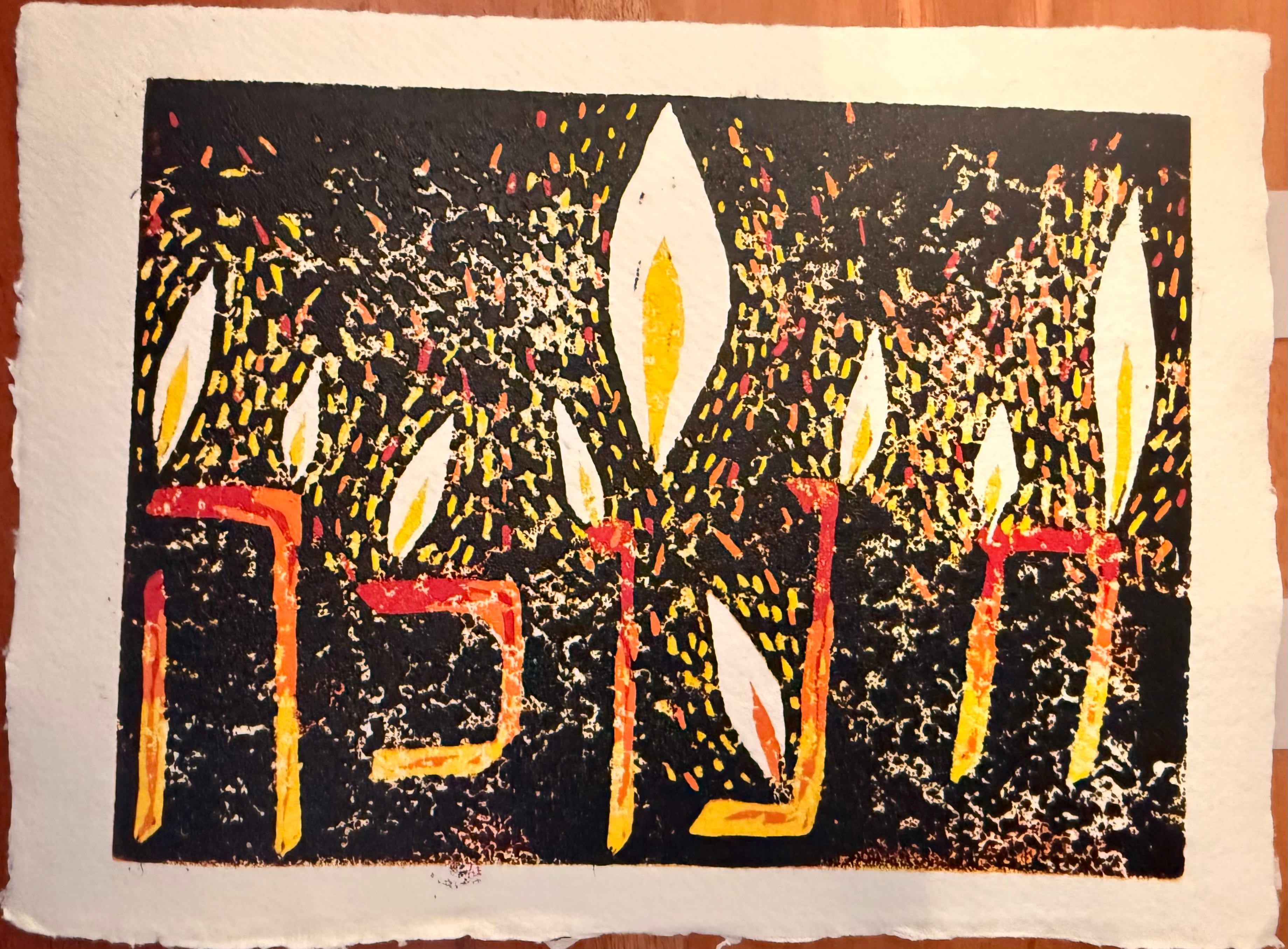
Print by R.Robyn, Chanukah 5786.
A copy of the piece can be found below but please do go and look at the whole resource as otherwise you will be missing out on some treasure!
The tale below is a fan-fiction short story based on both the plot, imaginings and wisdom of Ursula le Guin and her story, The Ones Who Walk Away From Omelas, and the apocryphal Book of Judith (with just a little nod to Hagar).
The City of the Judians
By Rabbi Robyn Ashworth-Steen
Judith paused outside the central tent. She could hear the chief Judians deep in conversation. The deliberation had just concluded and the group had decided, according to their custom of collaborative decision making and consciousness raising, to leave their encampment at The Well of the Living One Who Sees Me. The rumours had spread through camp like wildfire a few days ago, promises of a city like no other. A place far up in the mountains which had the greatest of views. A society where none suffered and everyone’s needs were met and resources were plentiful.
Judith was wary but also she was tired. She knew her time was coming and her people needed a place to settle after so long trekking, teaching and forming their group. To be up in the mountains was attractive - these horizons without end made Judith uneasy. It was time.
————-
The last notes of the melodies which had carried the Judians to the gates of the city, vibrated through and around them. Judith stood central and at the front of her large group of women who had committed themselves to a life in community, of the hard work of constructing and maintaining a group that was founded on the radical principles of accountability, transparency and justice.
Judith held out her sceptre and knocked on the gate. The Judians were quiet as they took in the jewelled, towering gate. It seemed strange to have such an opulent object placed on the mountain. Their eyes looked up and up, away from the scenery around them, the crevasses and the fissures, up and up to the top of the huge structure before them.
The gate opened. ‘Who goes there?’, the gatekeeper asked. ‘It is I, Judith of the Judians. I and my fellow Judians seek a home in this City of Omelas. May we enter. We are strong and have much wisdom to share.’
The gatekeeper replied in a tone that, ever so slightly, made Judith’s skin crawl and the chief Judians grip their swords more tightly. ‘You may enter the city of the renowned Omelas. Though to do so you must enter the city’s basement. There you will find the secret to the city’s success and richness here at the peak of the mountaintops. Having understood the reason for our city’s existence you may then either choose to enter the city and settle as one of us, or leave. The choice will be yours.’
The Chief Judians conferred after hearing from the people, young and old alike. They were unsure and were suspicious of any society that used secrecy and trickery but they had come this far. They began the short descent by the city’s wall to another gatekeeper by the basement doors, dull and unimpressive compared to the doors before.
——-
The Judians slowly entered the dark, musty and malodorous basement. Judith was first to see the most terrible site. She screamed and fell upon her face. In the corner of the room, chained, mute and dishevelled was a young girl. Barely clothed, she was seated on the cold stone tiles next to a bowl with water, like a dog. ‘Here’, the gatekeeper boomed, ‘is what enables our success. Because of the sacrifice of this child we prosper. Thanks to her suffering we no longer suffer. Now you have seen that which upholds our city you may enter. You will never speak of this child again or visit this basement. Or you may leave. The choice is yours.’
The Judians did not need to communicate verbally. They had been through too much, fought and worked too hard, on becoming all that they were. They fell on their faces, ran their hands through the dirt and dust around them and smeared it on their heads as times of old. They cried in a loud voice, led by Judith, the creed of the Judians - ‘it shall not be so. Break down their stateliness by the hands of a woman. For your power is not found in numbers or your might in strong men; for you are a God of the afflicted, a helper of the oppressed, an upholder of the weak.’
And so the Judians defied the gatekeeper and unlike any other traveller before them who had either chosen to overlook the suffering, tortured child to reap the benefits of the city, or those who left unable to stomach the incongruence, the fierce Judians chose another path. Overpowering the gatekeeper, they gently unchained the child. They wrapped her, carefully noting the wounds she carried, and held her as one of their own. As they caressed the child the bricks around them began to buckle, a sign of the city’s fragility now obvious to all, without the prop of a martyr and scapegoat for all the city’s richness. The Judians left the basement walking through the streets heralding the child as they beat their chests and tore their clothes whilst wailing. The citizens of the Omelas fled, the rulers in their ivory towers were so stunned they turned into stone where they stood. People fled and the Judians and the child remained. The city fell, brick by brick.
——-
So it was that the Sanctuary of Judian was built, on the ruins of the City of Omelas. A place that symbolised the possibility of choosing another path, of never being satisfied with the sacrifice and suffering of one for the many. A place which refused to conquer the mountain but to live within it and as part of it. A society which breathed as one whilst celebrating all and every. A sanctuary which ruthlessly lived out its values of justice and courage, of strength and compassion.
Even today you can find the gatekeepers set in stone, part of the garden of the City of the Judians. A reminder to all of the price that is paid for chasing power at the expense of others.